Quranic Soul Food – a recording by Imam Abdul Latif Finch

The Unlimited Mercy Team HIGHLY RECOMMENDS this recording by Imam Abdul Latif Finch. Below is an extract from his talk ‘Quranic Soul Food’

Click HERE to listen to the Quranic Soul Food recording

Imam Abdul Latif Finch Soulfood 1

Muhammad Abdul Latif Finch converted to Islam at the age of 20 and has earned ijazas in Islamic Sciences including Quranic Sciences, Hadith, Maliki and Shafi’i Jurisprudence, Usul al-Fiqh, Seerah, Logic, and Arabic Grammar and Morphology under the tutelage of numerous scholars, including Shaykh Hamza Yusuf, Shaykh Salik bin Siddina, Imam Zaid Shakir, Shaykh Abdur Rahman Taahir, Qari Umar Bellahi, Shaykh Abdullah Ali, and Shaykh Yahya Rhodus.

Imam Muhammad Abdul Latif Finch co-founded the Lighthouse Mosque in Oakland, California where he served as the Imam till for 3 years until he resigned in 2012 to focus on his graduate studies. In addition, he was a teacher and a program developer for Deen Intensive Foundation, Seekers Guidance and has assisted Zaytuna College ‘s Summer Arabic Intensive program for three years in a row.

Imam Muhammad Abdul Latif Finch has recently attained a Master’s degree in Philosophy from the Dominican School of Philosophy and Theology, a member of the Graduate Theological Union in Berkeley.

Many thanks to Imam Muhammad Abdul Latif Finch for contributing to this blog.

< Imam Muhammad Abdul Latif Finch’s lectures

< Imam Muhammad Abdul Latif Finch’s quotes

< Imam Muhammad Abdul Latif Finch’s thoughts

< Imam Muhammad Abdul Latif Finch’s articles

< Back to homepage

< About us

Aḥmadiyya and the Nature of Muḥammadaic Sainthood – an article by Imam Abdul Latif Finch

Introduction:

            Ḥ.m.d is an ‘Arabic root which indicates commendation, laudation. [1] A commendation is an expression of approval. To approve is “to attest (something) with authority.” [2] When these root letters are expressed in their various patterns, multiple meanings manifest for us to consider. “Aḥmad,” is such a name appearing as a form of these foundational letters, which will be contemplated here. The Quran embraces this form when addressing the Messenger of God, (ﷺ), when it states,

And [mention] when Jesus, the son of Mary, said, “O children of Israel, indeed I am the messenger of Allāh to you confirming what came before me of the Torah and bringing good tidings of a messenger to come after me, whose name is Ahmad.” But when he came to them with clear evidences, they said, “This is obvious magic.” [61:66]

Regarding this Qurānic sign, Shaikh Ibrāhīm Niās, may God be pleased with him, stated

“…of the Torah and bringing good tidings of a messenger to come after me, whose name is Aḥmad,” ‘(‘Isā, (ﷺ)) gave glade tidings regarding the coming of the Prophet, (Muḥammad) (ﷺ) and that his name in the revealed books was “Aḥmad.” God preserved this name such that He never named any one such before the Messenger, upon him be peace, so that there wouldn’t be any ambiguity (as to who is referred to when the name is used). His name Muḥammad signifies the time his appearance drew close. The monks and priests discussed the fact that a messenger named Muḥammad is to come from the Inviolable Precinct (in Makka). There were six children from amongst his people named “Muḥammad.” They include Muḥammad ibn Salma, Muḥammad ibn Aḥyaḥa…however none of these children had amongst them anyone who claimed to be a prophet nor have a state that would cause anyone to speculate about him being the Messenger of God( ﷺ).

“…whose name is Aḥmad,” he said, (ﷺ), ‘I have five names. I am Muḥammad. I am Aḥmad. I am al-Māḥī, by whom God erases disbelief. I am al-Ḥāshr, the one who gathers the people at my feet. I am al-‘Āqib, the last of the Prophets. I am Ṭāhā. I am Yāsin. He has a thousand names, the most famous of which are his name in the heavens, “Aḥmad,” and “Muḥammad.”


Aḥmad is an exaggerated expression of the concept of praise (fi-l ḥamd). Muḥammad is on the pattern of mufa’al of the concept of praise that acts as an amplification of praise as well. Also from the names is al-Ḥamādūn. The previous books depict the community of Muḥammad as al- Ḥamādūn, those who praise God in every state. When they eat, they say, ‘al-ḥamdulillah.’ When they drink they say, ‘al-ḥamdulillah.’ When they put on clothing they say, ‘al-ḥamdulillah.’ In good times they say, al-ḥamdulillah,’ and in bad times they say, ‘al-ḥamdulillah.’ (They also say it) when they die, when resurrected, and when they enter into Paradise.’ [3]


Here we will demonstrate that “Aḥmad,” indicates the intimate friendship that the Prophet (ﷺ) has with God, reflected in the authority to praise Him. This clout consequently denotes some of the mastery inherent in the slavery of the Messenger of God, (ﷺ). All these characteristics manifest in his sainthood or Aḥmadiyya.

Al-Walī is one of the Divine Names. The Book mentions, “Alläh is the Walī of those who believe; He causes them to come out of the darkness into the light [2:257]” and “Allāh is the Walī of the pious.” [45:19] Obviously God’s attributes have neither beginning nor end. When applied to human beings, the name does have limitations. Michel Chodkiewicz mentions some of these constraints

‘The Muslim exegetes […] attempted to classify the different meanings of wali in the sacred Book. Muqātil (eighth century) detected ten meanings which can in fact be reduced to two. The first is directly related to the idea of proximity […] is the primary meaning of the root, and signifies, according to the context, ‘friend,’ ‘companion,’ ‘relative,’ ‘ally,’ ‘counselor.’ The second meaning is ‘protector’ or ‘governor.’ The existence of these two classes of meaning is connected with the very nature of the word wali. This word is constructed on the ambivalent fa’īl pattern which in Arabic can possess both an active sense (normally expressed by the form fā’il) and a passive sense (corresponding to the form maf’ūl). Thus the wali is simultaneously one whom is close, the beloved, he who is protected, taken in charge, and the protector, the ‘patron’ (in the Roman sense), the governor (al-walī, the active principle constructed on the fā’il paradigm. [4]

According to Muqātil, the root word w.l.y. may be considered in two capacities. The first (walāya) is the common application of the term wali (commonly translated as, “saint.”), i.e., one whom is God’s friend, having all the makings of one drawn near to God. This aspect of the term may be exemplified in the Quranic sign, “Know well that the confidants (saintly servants) of God; there will be no reason for them (awliyā, the plural of wali) to fear, nor shall they grieve.” [5] [10:62]

An object is known through its attributes. The one who knows another’s attributes best may be said to be the most intimate in knowledge of the latter. The walī (saint) is intimate with the knowledge of God. Therefore, he/she is familiar with God’s attributes. God’s attributes are essentially praiseworthy. Therefore, the walī is closely acquainted to His fundamental praiseworthiness. Every prophet is a walī. The Prophet (ﷺ) is the best of the prophets. As his walāya is commensurate with his prophethood and he (ﷺ) is the greatest of the prophets, it follows that he is also the greatest of the awliyā and the most capable of praising Him due to his superbly intimate knowledge of God’s attributes. His name, “Aḥmad,” or “The Most Praising” indicates this station as Shaikh Ibrāhīm mentioned above, “Aḥmad is an amplified expression of the concept of praise (fi-l ḥamd).” The Most Praising is also the most intimate. When one is intimate with another there is a kind of synchronicity between the two. According to ‘Amr ibn al-Jamūḥ, the Prophet,(ﷺ) stated “the awliyā are those who, when you see them, you are reminded of Allāh.” [6] In other words, the intimacy between the friend of God and their Maker is such that to see the former is to “see” the latter though only symbolically. The Divine Tradition says, “My awliyā among My servants, and My beloved among My creatures are those who are remembered with My remembrance, and I am remembered with their remembrance,” [7] a statement that further emphasizes this point. After all, one can say “Allāh” without remembering the Prophet (ﷺ) but one cannot say “Aḥmad “ without remembering Allāh. Therefore, the name “Aḥmad” indicates the intimate friendship or walāya that the Prophet (ﷺ) has with Allāh.

The second application of the root word w.l.y. as explicated by Muqātil above (wilāya) provides for a more terrestrial application of the term walī; one who governs. To repeat the previous formula, one is known through their attributes. The one who knows another’s attributes best may be said to be the most intimate with the latter’s characteristics. The walī is intimate with God. Therefore, he/she is familiar with God’s attributes. God’s attributes are essentially praiseworthy. Therefore, the walī is closely acquainted to His fundamental praiseworthiness. Therefore, as compared to one who is not as closely associated, the walī serves as an authority regarding God’s praise. One who has authority regarding God’s praise is rewarded with God’s pleasure. The one rewarded with God’s pleasure has God on his/her side. The one with God’s assistance is victorious in the earth. Therefore, it is through God’s ḥamd (praise) that the walī yields influence in the world and the hereafter.

An anecdote of such worldly authority is found in the Leader of the Faithful, Umar ibn al-Khaṭāb, may Allāh be pleased with him

It has been narrated on the authority of ‘Abdullah bin ‘Umar that ‘Umar, may Allāh be pleased with them, had sent an army for a military campaign. He had appointed a person as the leader of this army, who was called “Sāriya.” While ‘Umar, may Allāh be pleased with him, was giving a sermon, he started saying: O Sāriya! To the mountain! After this, a message-bearer came and said: O Commander of the faithful! We were fighting against our enemies. They had almost defeated us. When we heard someone calling out: O Sāriya! To the mountain! We stood with the mountain at our back and Almighty Allāh gave them a crushing defeat. [8]

As the khalīfa (vicegerent) of Aḥmad (ﷺ) he was also both a governor and a friend of God through proximity to His praise at one and the same time. As such, he had God’s facilitation to cause Sāriya to hear him at a mountain in Persia, hundreds of miles away. He was able to do so through Allāh’s leave alone and by virtue of his association with the Messenger of Allāh (ﷺ). This indicates that the Prophet’s (ﷺ) that the intimacy and authority endures in his representatives after him.[9]

‘Umar, may God be pleased with him, occupied the station of the external regency of the Prophet (ﷺ). Acting as Aḥmad’s substitute (ﷺ), the new khalīfa’s task was to further establish the worship of God on the planet. One charged with such a task has been given authority regarding h.m.d. (praise). Both Umar’s success in expanding the borders of Islām, and the open miracles he performed show the support he received from the Divine. It follows that his own state of intimate friendship with God or Aḥmadiyya proves this station’s authority to praise Him in this world.

As mentioned above, the name al Walī belongs to God. His Names abide forever. The Hereafter is a realm without end. The one blessed with the name walī, then, is suited for the Hereafter for like his name suggests, his/her station will also endure permanently in the Hereafter. As the Prophet (ﷺ) is the greatest walī, his authority will manifest in a superior fashion in the Hereafter just as it does in this world. The Messenger of Allah (ﷺ) said: “I am the master of the children of Adam on the Day of Judgment, and I am not boasting. The Banner of Praise will be in my hand, and I am not boasting. There will not be a Prophet on that day, not Adam nor anyone other than him, except that he will be under my banner. And I am the first one for whom the earth will be opened for, and I am not bragging.” [10] We see the honor that he has, ﷺ regarding praise’s banner here. We also see that the Prophet Muhammad (ﷺ) is master of the descendants of Adam (ﷺ). This fact is apparent in at least two ways: his slavery and mastery. Both aspects are manifested in the following tradition:

It was narrated from Abu Hurayra, may Allāh be pleased with him, that the Messenger of Allāh (peace and blessings of Allāh be upon him) said: “I will be the leader of mankind on the Day of Resurrection. Do you know why that is? Allāh will gather mankind, the first and the last of them, in one place, so that the caller will be able to make them all hear his voice and the watcher will be able to see them all. The sun will be brought close and the people will suffer such distress and trouble that they will not be able to bear it or stand it. The people will say, ‘Don’t you see in the state you are in and the condition you have reached? Why don’t you look for someone who can intercede for you with your Lord?’ The people will say to one another: ‘Go to your father, Adam.’ So they will go to Adam (ﷺ) … I will go and prostrate beneath the Throne. Then I will be given words of praise such have never been given to anyone before me, then it will be said, ‘O Muhammad! Raise your head; ask, for it will be given to you, and intercede, for your intercession will be accepted.’ I will raise my head and say, ‘My ummah, O lord! My ummah, O Lord!’ It will be said, ‘O Muhammad, admit from among your ummah those who will not be brought to account from the right-hand gate of Paradise, and they will share the other gates with the people.’ He said, By the One in Whose hand is my soul, the distance between two of the gate-posts is like the distance between Makkah and Humayr, or between Makkah and Busra.” [11]

Here, on the Day when all people will be concerned over their own fate, the Prophet (ﷺ) will be concerned about all of humanity. A weak tradition states, “The servant of a people is their master,” [12] however, its meaning is emphatically strong. Given that the Prophet (ﷺ) will serve as the intercessor for the Day of Judgment to relieve people from the agony of awaiting

On the Day when all people will be concerned over their own fate, the Prophet (ﷺ) will be concerned about all of humanity

On the Day when all people will be concerned over their own fate, the Prophet (ﷺ) will be concerned about all of humanity

judgment, we can see the extent of his service to mankind. As the Great Intercession is an honor only granted to him (ﷺ), his mastery over the rest of creation seems abundantly clear as all will rush to him on that Day, prophet and non-prophet alike. This authority eloquently reflects some of the mastery inherent in the slavery of the Messenger of God (ﷺ).

A perfect wali (one drawn close and one who governs) or has complete Aḥmadiyya, a fact that may be illustrated in the famous tradition of Abū Hurayra, may God be pleased with him, who narrated through the Prophet (ﷺ) that God said

Whosoever shows enmity to My friend, I shall be at war with him. My servant draws not near to Me with anything more loved by Me than the religious duties I have enjoined upon him, and My servant continues to draw near to Me with supererogatory works so that I shall love him. When I love him I am his hearing with which he hears, his seeing with which he sees, his hand with which he strikes and his foot with which he walks. Were he to ask [something] of Me, I would surely give it to him, and were he to ask Me for refuge, I would surely grant him it. I do not hesitate about anything as much as I hesitate about [seizing] the soul of My faithful servant, he hates death and I hate hurting him. [13]

It may be understood from the words, “were he to ask [something] of Me, I would surely give it to him,” that this person has a special kind of access to God. This specialness is a result of his/her submission to Him. This harmony may reach such a stage that whatever He wants is what he wants. This relationship manifests in the latter’s supplications being answered and God’s will manifest through him/her on the earth. Indeed, this appears to epitomize the meaning of the term khalīfa (vicegerent), the representative of God’s presence in the terrestrial realm. With reference to these two aspects, Imam al-Qushayri states, “Both of these descriptions are necessary for a wali to be a true wali, from his discharge of the rights due to God Most High through close study and full performance and God’s continual protection of him in joy and sorrow. “ [14]

To this end, Chodkiewicz states regarding these two aspects of intimate and friendship:

One of these is ‘to be a friend,’ and the other is ‘to direct, to govern, to take charge.’ Thus the walī, and properly speaking, is the ‘friend,’ he who is close; but as ibn Manẓur emphasizes in the Lisān al-‘arab, he who is also the nāṣir, ‘he who assists’ and the mudabbir, he who disposes. [15]

The two faces of the root w.l.y. (walāya and wilāya) merge into the personality of the individual described in the above tradition. The one who has intimacy with God’s praise is given intimacy and authority. The Prophet’s name, Ahmad denotes the intimate friendship, and authority of the Prophet’s (ﷺ) attributes manifested in the servant hood of the Prophet (ﷺ) as attested to in the display of his slavery on the Day of Judgment; a submission that will earn God’s attention, and grant him, ﷺ the authority that will cause people who were at a distance from God to have His intimacy, God willing.

Conclusion

We have stated above that when we look at the subject of God’s praise, the name “Aḥmad” indicates the intimate friendship or walāya that the Prophet (ﷺ) has with Allāh. Through the same evaluation we have shown that it is through God’s ḥamd (praise) that the walī yields influence in this world and the hereafter through their wilāya. The authority afforded to the Prophet, Aḥmad, (ﷺ) on the Last Day is, arguably, the objective of the appearance of the name al-Walī made manifest through him, ﷺ , and eloquently reflects some of the mastery inherent in the slavery of the Messenger of God (ﷺ). As such, the Prophet’s name Aḥmad is indicative of an inner reality or Aḥmadiyya, (sainthood) lying beneath his prophet hood that endures well after prophecy has ended in the world. It is both the epitome of intimacy with God and authority within His creation.

Imam Muhammad Abdul Latif Finch

2015


[1] The Hans Wehr Dictionary of Modern Written Arabic s.v. “Hamd.”

[2] Douglas Harper, “Commendation” http://etymonline.com/index.php?term=commendation&allowed_in_frame=0 (accessed January 21, 2014).

[3] Ibrāhīm Niās, Fī Riyāḍ Al-Tafsīr, vol. 5 (Tunis: Majma’ al-Yamāma li-al-Ṭabā’a wa-al-Nashr wa al-Tawzī’, 2010), 135-137. For an exact tradition that confirms the multiple names of the Prophet, (ﷺ), see Shamā-il Tirmidhī Chapter 051, Ḥadīth Number 001 (360).

[4] Michel Chodkiewicz, Seal of Saints (Cambridge: The Islamic Texts Society, 1993), 24.

[5] The Quran refers to God’s friendship in several instances in the Book.  “Allāh is the Walī of those who believe; He causes them to come out of darkness into light.” [2:257] “Allāh is the Walī of the pious.’ [45:19] Know you not that it is Allah to Whom belongs the dominion of the heavens and the earth? And besides Allah you have neither any Wali (protector or guardian) nor any helper. [2:107] Verily, among mankind who have the best claim to Ibrahim (Abraham) are those who followed him, and this Prophet (Muhammad SAW) and those who have believed (Muslims). And Allah is the Wali (Protector and Helper) of the believers. [3:68] Allah has full knowledge of your enemies, and Allah is Sufficient as a Wali (Protector), and Allah is Sufficient as a Helper. [4:45] Your ally is none but Allah and [therefore] His Messenger and those who have believed – those who establish prayer and give zakah, and they bow [in worship]. [5:55] Indeed, those who believe and do righteous deeds and establish prayer and give zakah will have their reward with their Lord, and there will be no fear concerning them, nor will they grieve. [2:277]

[6] For the specifics regarding this tradition see Gibril Fouad Haddad, The Muhammadan Light (Londom: Centre for Spirituality and Cultural Advancement, 2012), 268-269.

[7] For details regarding this tradition see ibid., 269.

[8] Dalāil al-Nubuwwah, Ḥadīth No. 2655; Mishkātul Masabīḥ, Bab al-Karamāt; Zujaja al-Masabīḥ, Bab al-Karamāt)

[9] These representatives are found scattered throughout the world. It is to this end that we find a report that states,”

Verily, ‘Umar, may God be pleased with, exited the mosque.  He found Mu’ādh crying at the grave of the Messenger of Allāh (ﷺ). So he asked him, ‘What makes you cry?’ ‘Words I heard from the Messenger of Allāh (ﷺ) who said, ‘The slightest example of ostentation is polytheism. Whoever shows enmity with one of God’s friends has had a declaration of war made against him. Allāh loves the exposure of the hidden ones who are God-conscious whom were they to disappear no one would miss them. When they are present no one knows them. Their hearts are lamps in the darkness. They come forth from every gloomy recess of the Earth.’ Narrated by Mu’ādh ibn Jabal as found in the collection of al-Hāfiḍ a-Mundharī in his “al-Targhīb wal-Tarhīb 148/4

[10] Jāmi’ al-Tirmidhī, Chapters on Virtues, Ḥadīth 3975

[11]  al-Bukhārī, 4712

[12] Narrated by Ibn ‘Abbās, Anas ibn Mālik, and Sahl ibn Sa’d. Anas’s version states, “The servant of a people is their master and the one who gives them drink is the last to drink.

[13] Al-Bukhārī

[14] Abu’L-Qasim al-Qushayri, Sufi Book of Spiritual Ascent, trans., Rabia Harris, 4th ed. (Chicago: KAZI, 2006), 249-250.

[15] Chodkiewicz, 21.

Sources

al-Qushayri, Abu’L-Qasim. Sufi Book of Spiritual Ascent. Translated by Rabia Harris. 4th ed. Chicago: KAZI, 2006.

Chodkiewicz, Michel. Seal of Saints. Cambridge: The Islamic Texts Society, 1993.

Haddad, Gibril Fouad. The Muhammadan Light Londom: Centre for Spirituality and Cultural Advancement, 2012.

Harper, Douglas, “Commendation” http://etymonline.com/index.php?term=commendation&allowed_in_frame=0 (accessed January 21, 2014).

Niās, Ibrāhīm. Fī Riyāḍ Al-Tafsīr. Vol. 5. Tunis: Majma’ al-Yamāma li-al-Ṭabā’a wa-al-Nashr wa al-Tawzī’, 2010.

Wehr, Hans, The Hans Wehr Dictionary of Modern Written Arabic London:Macdonald and Evans, Ltd., 1974.


Muhammad Abdul Latif Finch converted to Islam at the age of 20 and has earned ijazas in Islamic Sciences including Quranic Sciences, Hadith, Maliki and Shafi’i Jurisprudence, Usul al-Fiqh, Seerah, Logic, and Arabic Grammar and Morphology under the tutelage of numerous scholars, including Shaykh Hamza Yusuf, Shaykh Salik bin Siddina, Imam Zaid Shakir, Shaykh Abdur Rahman Taahir, Qari Umar Bellahi, Shaykh Abdullah Ali, and Shaykh Yahya Rhodus.

Imam Muhammad Abdul Latif Finch co-founded the Lighthouse Mosque in Oakland, California where he served as the Imam till for 3 years until he resigned in 2012 to focus on his graduate studies. In addition, he was a teacher and a program developer for Deen Intensive Foundation, Seekers Guidance and has assisted Zaytuna College ‘s Summer Arabic Intensive program for three years in a row.

Imam Muhammad Abdul Latif Finch has recently attained a Master’s degree in Philosophy at the Dominican School of Philosophy and Theology, a member of the Graduate Theological Union in Berkeley.

Many thanks to Imam Muhammad Abdul Latif Finch for contributing to this blog.

Imam Muhammad Abdul Latif Finch’s website

Imam Muhammad Abdul Latif Finch’s Twitter page

Imam Muhammad Abdul Latif Finch’s LinkedIn page

Imam Muhammad Abdul Latif Finch’s Soundcloud page

Imam Muhammad Abdul Latif Finch’s Soundcloud page #2

< Rest of Imam Muhammad Abdul Latif Finch’s articles

< Imam Muhammad Abdul Latif Finch’s quotes

< Imam Muhammad Abdul Latif Finch’s thoughts

< Back to homepage

< About us

Faith and God’s Self-Evident Praise – an article by Imam Abdul Latif Finch

The most important aspect of the faith of Islam is the belief in the oneness of God. This oneness is understood to be his unity in His Essence, Names, Attributes and Acts. Commenting on God’s words, “Say, ‘With Allah is the far-reaching proof. If He had willed, He would have guided you all,’” al-Qurṭubī states that God’s far reaching proof or argument is…

…that which undercuts the justification of the one subsequently disproven and removes the doubt of the one who investigates it. His proof indicated here is that He is One, and His sending of the Messengers and Prophets. His oneness is made evident by virtue of observing creation. His sending the Messengers is made clear by his aiding them with miracles…

In other words, according to him, God’s far –reaching proof is something evident. This is quite a paradox as will be illustrated below. His unity is clear to those who see that all entities, for example, are unique: no two of them are identical. In this way, all are “one.” In other words, if all things were given a numerical representation they would all be the number “1.” This kind of illustration would have, for example, all the individual letters on this page to be seen as, 1111 111 11111 1111 111. If one were to lift their eyes off the page they would see the same number all around them. If they were to look in the mirror a matching number one would be staring back at them. Who gives them this sense of unity to all things but a Lord who Himself has this quality but in His own unique fashion? As for the Messengers, upon whom be peace, if activities were random and devoid of any designer then how does a miracle impress anyone when all acts would then be miraculous. Rather, it’s evident that there is a pattern and hence a Pattern Maker. It’s only when the miracle comes and breaks the pattern that we notice the presence of the pattern and call an act a “breaking of norms.” Both acts, those based in the pattern and those outside of it seem to show the evident nature of their Maker.

Faith, we should understand, is not the proof that would support it. If faith and proofs were equated, then were a proof to be disproven, faith would be refuted along with it. Likewise, if faith were a matter of proofs, then all one would have to do is understand the proofs of faith in order to have it. This is often not the case for God states, “And Moses had certainly brought you clear proofs. Then you took the calf [in worship] after that, while you were wrongdoers.” [1] Despite the clear proofs brought by Moses, his followers had weak to zero faith. Faith, rather, is something that stands on its own that comes directly from God as something self-evident. The Book says, “So whoever Allah wants to guide – He expands his breast to [contain] Islam; and whoever He wants to misguide – He makes his breast tight and constricted as though he were climbing into the sky. Thus does Allah place defilement upon those who do not believe.” [2] Here I will show that God’s praise, like faith, is self-evident, and therefore, not in need of proofs.

The Nature of Proofs

A proof is that which inclines to prove or disprove something other than itself. This evidence is sufficient to establish a thing outside the proof to be true. In order for a proof to be considered it must be established as true. If it has that kind of integrity then it may bring that which does not have the same kind of truth-ness into a state of truthfulness. In this sense, that which is to be proven is inferior to its proof. If God’s existence is to be established by proofs then His existence is inferior to these evidences. This presents a problem for, as mentioned above, God is one in all of His aspects. That which is one in all of its aspects does not have a rival in any of them. His Being, then, is rival-less. He whose existence is without a competitive existence is also not subject to inferiority or superiority with regard to any would-be viable existence. In other words, it’s inappropriate that God be proven for He is neither in need of anything, far less a proof, nor could there ever be a proof that would establish His existence as it’s own existence requires God’s own existence. Those who believe in God then, don’t believe in proofs for the above explanation. They simply have faith.

The Nature of Faith

Faith may be defined as a belief that is not based on proof. That which is not based on something else is not in need of it. Faith, therefore, is independent of proofs. As a proof is that which requires something outside of itself to establish it to be true and faith is that which does so without recourse to proofs, the two are mutually exclusive. In other words, faith and proof do not co-exist. That existent which doesn’t require proofs is obvious. As such, faith is self-evident. It occurs whenever and however God determines it to exist. It may also be removed as instantaneously. The tradition states,

Rush to perform (good) deeds now, before fitan (trials and tribulations) of pitch-black darkness (appear), wherein a man wakes up as a believer and becomes a disbeliever by nightfall, and another man goes to bed as a believer and wakes up as a disbeliever… [3]

In this hadith the Prophet, peace be upon him, mentions a time, “wherein a man wakes up a believer and becomes a disbeliever by nightfall, and another man goes to bed as a believer and wakes up a disbeliever.” If faith were something based in proofs, as long as a person knew these proofs their faith could not come and go so easily. Rather, faith is something apparent that exists in the heart or it is not. May Allah protect us from losing the obvious.

The Nature of The Self-Evident

That whose existence is not in need of proofs is termed to be “self-evident.” That which is self-evident is discernible. An example of the self-explanatory is the fact that we exist. Some would say that even our own existence is subject to debate. However, if we didn’t exist then the question about our existence would not occur. So, therefore, to question my existence presupposes our existence that might be questioned. At any rate, our own existence is not in need of proofs, it seems, and so therefore “I” am self-explanatory as well. “I” am the first thing that “I” know as a child and so therefore the basis of our understanding is on that which is self-evident; our own existence. So, the self-evident is, like our own sense of self, axiomatic: manifest, accepted and clear. That which is evident is not in need of proofs. That which is not in need of proofs is praised for its clarity. “Their messengers said, “Can there be doubt about Allah.” [4] Our relationship with God is based in faith. Faith, as mentioned above, is something evident. That which is evident is not subject to doubt. Therefore, just as there are no proofs for Allah there can be no doubt in Him. That which is free from doubt is true. That which is true is praiseworthy.

Good and bad are particular examples of existence and therefore are both equally in reference to God. The Book says, “If any good reaches them, they say, “This is from Allah,” but if any evil befalls them, they say, “This happened because of you.” Say: “All things are from Allah.” What is wrong with these people that they do not understand any word? “ [4:78] - Imam Abdul Latif Finch

Good and bad are particular examples of existence and therefore are both equally in reference to God. The Book says, “If any good reaches them, they say, “This is from Allah,” but if any evil befalls them, they say, “This happened because of you.” Say: “All things are from Allah.” What is wrong with these people that they do not understand any word?” [4:78] – Imam Abdul Latif Finch

The Nature of Praise

To be praised is to exist in the state of being approved or admired. In order to be approved or admired one must first be mentioned. Therefore, praise is based in reference. All activity points to an actor. Existence is an activity. Therefore existence points to one who causes it to occur. In this sense all entities reference or mention this Actor. Good and bad are particular examples of existence and therefore are both equally in reference to God. The Book says, “If any good reaches them, they say, “This is from Allah,” but if any evil befalls them, they say, “This happened because of you.” Say: “All things are from Allah.” What is wrong with these people that they do not understand any word?[5] Perhaps we cannot understand any word because we are left to our own judgments about them which causes us to be veiled from the Truth that is behind them?

I say that we cannot decide whether or not some event is ultimately good or bad unless one knows its ultimate ending when time and space finish. As creatures with only temporal orientations, we cannot know the atemporal result of any event; this is why the Day of Judgment must come for the ultimate end of every act will become clear. As such we cannot make judgments about anything outside of our perspective for we are not God and this is not the Day of Standing. Rather, the final say lies with the Actor who is beyond all events. As all activities lead to God, all acts are in reference to Him. This universal mention orients all creatures to their Maker. As objects oriented toward the Lord, He is above them in every sense. This exaltation or praise is absolute for, “Whatever is in the heavens and whatever is on the earth is exalting Allah, the Sovereign, the Pure, the Exalted in Might, the Wise.” [6] There is nothing outside the heavens and the earth and there is one act of reference to that which is above them. This exaltation comes from them to one Receiver of this Praise. As there is no one more appropriate for this referencing, all Praise or referencing is due to Allah.

Conclusion

That which is absolute is complete. That which is complete is sufficient. That which is adequate doesn’t require help. That which doesn’t require help stands alone. As stated above, proofs serve to assist. Faith doesn’t require backing, as it stands alone. Therefore faith stands alone without partner, yet in a created sense of the idea. Likewise God’s praise has been shown to be total. That which is ample is not in need of additions. Therefore, God’s praise stands alone without partner. All of this, upon deliberation, seems self-evident. That which is self –evident stands alone and has no partner, and this is true for both God and His creature that reflects His aloneness. Ironically then, the praise of God who is Himself alone and has no partner, like the faith in our hearts, is self-evident, and therefore, not in need of proofs. This oneness seems to be a self-evident and far reaching proof. May Allah guide us all. Amin.

Imam Muhammad Abdul Latif Finch

June 2015


[1] Quran 2:92

[2] Quran 6:125

[3] Ṣaḥīḥ Muslim

[4] Quran 14:10

[5] Quran 4:78

[6] Quran 62:1

Muhammad Abdul Latif Finch converted to Islam at the age of 20 and has earned ijazas in Islamic Sciences including Quranic Sciences, Hadith, Maliki and Shafi’i Jurisprudence, Usul al-Fiqh, Seerah, Logic, and Arabic Grammar and Morphology under the tutelage of numerous scholars, including Shaykh Hamza Yusuf, Shaykh Salik bin Siddina, Imam Zaid Shakir, Shaykh Abdur Rahman Taahir, Qari Umar Bellahi, Shaykh Abdullah Ali, and Shaykh Yahya Rhodus.

Imam Muhammad Abdul Latif Finch co-founded the Lighthouse Mosque in Oakland, California where he served as the Imam till for 3 years until he resigned in 2012 to focus on his graduate studies. In addition, he was a teacher and a program developer for Deen Intensive Foundation, Seekers Guidance and has assisted Zaytuna College ‘s Summer Arabic Intensive program for three years in a row.

Imam Muhammad Abdul Latif Finch has recently attained a Master’s degree in Philosophy at the Dominican School of Philosophy and Theology, a member of the Graduate Theological Union in Berkeley.

Many thanks to Imam Muhammad Abdul Latif Finch for contributing to this blog.

Imam Muhammad Abdul Latif Finch’s website

Imam Muhammad Abdul Latif Finch’s Twitter page

Imam Muhammad Abdul Latif Finch’s LinkedIn page

Imam Muhammad Abdul Latif Finch’s Soundcloud page

Imam Muhammad Abdul Latif Finch’s Soundcloud page #2

< Rest of Imam Muhammad Abdul Latif Finch’s articles

< Imam Muhammad Abdul Latif Finch’s quotes

< Imam Muhammad Abdul Latif Finch’s thoughts

< Back to homepage

< About us

Symbols – a quote by Imam Abdul Latif Finch

“Sometimes we look at the symbol so long that we forget what it’s pointing at”

– Imam Muhammad Abdul Latif Finch

Imam abdul latif quote symbol

Muhammad Abdul Latif converted to Islam at the age of 20 and has earned ijazas in Islamic Sciences including Quranic Sciences, Hadith, Maliki and Shafi’i Jurisprudence, Usul al-Fiqh, Seerah, Logic, and Arabic Grammar and Morphology under the tutelage of numerous scholars, including Shaykh Hamza Yusuf, Shaykh Salik bin Siddina, Imam Zaid Shakir, Shaykh Abdur Rahman Taahir, Qari Umar Bellahi, Shaykh Abdullah Ali, and Shaykh Yahya Rhodus.

Imam Muhammad Abdul Latif Finch co-founded the Lighthouse Mosque in Oakland, California where he served as the Imam till for 3 years until he resigned in 2012 to focus on his graduate studies. In addition, he was a teacher and a program developer for Deen Intensive Foundation, Seekers Guidance and has assisted Zaytuna College ‘s Summer Arabic Intensive program for three years in a row.

Imam Muhammad Abdul Latif Finch has recently attained a Master’s degree in Philosophy at the Dominican School of Philosophy and Theology, a member of the Graduate Theological Union in Berkeley.

Many thanks to Imam Muhammad Abdul Latif Finch for contributing to this blog.

Imam Muhammad Abdul Latif Finch’s website

Imam Muhammad Abdul Latif Finch’s Twitter page

Imam Muhammad Abdul Latif Finch’s LinkedIn page

Imam Muhammad Abdul Latif Finch’s Soundcloud page

Imam Muhammad Abdul Latif Finch’s Soundcloud page # 2

< Rest of Imam Muhammad Abdul Latif Finch’s quotes

< Imam Muhammad Abdul Latif Finch’s thoughts

< Back to homepage

< About us

Mercy, a Gift to Mankind – a Thought by Imam Abdul Latif Finch

The Prophet, , has called himself simply an absolute gift. Abū Hurayra, may God be pleased with him, reported Allāh’s Messenger said,

“O People! I am only mercy gifted to you!” [1]

gift box

That is to say, if one were to ask just what the Prophet, is, the answer is a gifted mercy. Whatever is beyond the right of a dependent is a mercy. A gift is beyond the rights of the needy. Therefore a gift is a mercy. Hence, in this tradition he stated, , to all people without exclusion that he is but compounded mercy.

To compound something is to multiply it. The increased mercy here epitomizes the nature of his relationship with God’s dependents. These creatures have no foreseeable limit, as even the inhabitants of Paradise are dependent on God.  Therefore, the compounded mercy mentioned in the tradition of the Prophet has an unqualified nature. With this point in mind, it may be said that he, , is nothing more than unqualified mercy.

Imam Muhammad Abdul Latif Finch

May 2015

Imam Muhammad Abdul Latif Finch’s website

Imam Muhammad Abdul Latif Finch’s Twitter page

Imam Muhammad Abdul Latif Finch’s Facebook page

Imam Muhammad Abdul Latif Finch’s LinkedIn page

Imam Muhammad Abdul Latif Finch’s Soundcloud page

Imam Muhammad Abdul Latif Finch’s Soundcloud page # 2

[1] al-Darimi 1:21 Hadith #10 ;Ibn Abi Shayba in Al-Musannaf,6:325 Hadith #31782;Al-Hakim Al-Mustadrak 1:91 Hadith #100;Al-Tabarani in Al-Mu’jam Al-Awsat, 3:223 Hadith #2981; Al-Bayhaqi Sh’ab al-Iman 2:143 Hadith #1402;Al-Haythami in Majma al-Zawaid 8:257

< Rest of Imam Abdul Latif Finch’s thoughts

< Imam Muhammad Abdul Latif Finch’s quotes

< Back to homepage

< About us

Tragedy to diamond – a quote by Imam Abdul Latif Finch

“Sometimes we mistake tragedy as punishment from God but diamonds are made from compressed coal. Mercy in disguise.”

Imam Muhammad Abdul Latif Finch 2015

diamond

Muhammad Abdul Latif converted to Islam at the age of 20 and has earned ijazas in Islamic Sciences including Quranic Sciences, Hadith, Maliki and Shafi’i Jurisprudence, Usul al-Fiqh, Seerah, Logic, and Arabic Grammar and Morphology under the tutelage of numerous scholars, including Shaykh Hamza Yusuf, Shaykh Salik bin Siddina, Imam Zaid Shakir, Shaykh Abdur Rahman Taahir, Qari Umar Bellahi, Shaykh Abdullah Ali, and Shaykh Yahya Rhodus.

Imam Muhammad Abdul Latif Finch co-founded the Lighthouse Mosque in Oakland, California where he served as the Imam till for 3 years until he resigned in 2012 to focus on his graduate studies. In addition, he was a teacher and a program developer for Deen Intensive Foundation, Seekers Guidance and has assisted Zaytuna College ‘s Summer Arabic Intensive program for three years in a row.

Imam Muhammad Abdul Latif Finch has recently attained a Master’s degree in Philosophy at the Dominican School of Philosophy and Theology, a member of the Graduate Theological Union in Berkeley.

Many thanks to Imam Muhammad Abdul Latif Finch for contributing to this blog.

Imam Muhammad Abdul Latif Finch’s website

Imam Muhammad Abdul Latif Finch’s Twitter page

Imam Muhammad Abdul Latif Finch’s LinkedIn page

Imam Muhammad Abdul Latif Finch’s Soundcloud page

Imam Muhammad Abdul Latif Finch’s Soundcloud page # 2

< Rest of Imam Muhammad Abdul Latif Finch’s quotes

< Imam Muhammad Abdul Latif Finch’s thoughts

< Back to homepage

< About us

Death bed – a quote by Imam Abdul Latif Finch

“Very few things will matter to us at the time of death.”

Imam Muhammad Abdul Latif Finch

death

Muhammad Abdul Latif converted to Islam at the age of 20 and has earned ijazas in Islamic Sciences including Quranic Sciences, Hadith, Maliki and Shafi’i Jurisprudence, Usul al-Fiqh, Seerah, Logic, and Arabic Grammar and Morphology under the tutelage of numerous scholars, including Shaykh Hamza Yusuf, Shaykh Salik bin Siddina, Imam Zaid Shakir, Shaykh Abdur Rahman Taahir, Qari Umar Bellahi, Shaykh Abdullah Ali, and Shaykh Yahya Rhodus.

Imam Muhammad Abdul Latif Finch co-founded the Lighthouse Mosque in Oakland, California where he served as the Imam till for 3 years until he resigned in 2012 to focus on his graduate studies. In addition, he was a teacher and a program developer for Deen Intensive Foundation, Seekers Guidance and has assisted Zaytuna College ‘s Summer Arabic Intensive program for three years in a row.

Imam Muhammad Abdul Latif Finch has recently attained a Master’s degree in Philosophy at the Dominican School of Philosophy and Theology, a member of the Graduate Theological Union in Berkeley.

Many thanks to Imam Muhammad Abdul Latif Finch for contributing to this blog.

Imam Muhammad Abdul Latif Finch’s website

Imam Muhammad Abdul Latif Finch’s Twitter page

Imam Muhammad Abdul Latif Finch’s LinkedIn page

Imam Muhammad Abdul Latif Finch’s Soundcloud page

Imam Muhammad Abdul Latif Finch’s Soundcloud page # 2

< Rest of Imam Muhammad Abdul Latif Finch’s quotes

< Imam Muhammad Abdul Latif Finch’s thoughts

< Back to homepage

< About us

Birth, God & Unlimited Mercy – a Thought from Imam Abdul Latif Finch

Absolute free will is total freedom to do whatever one wants whenever one wants.

However, no one has the ability to choose when to be born.

Therefore, no one has absolute free will.

Without absolute free will human beings are left with relative free will.

That which is relatively free is fairly restricted.

That which is fairly restricted requires something that limits it.

This limitation may be natural to it or imposed.

That which is limited is necessarily incapable of imposing this same limitation.

So, that which has a restricted free will has its limitation imposed upon it necessarily.

That which necessarily chooses when the human being is to be born, it follows, has absolute free will regarding her.

That which has absolute free will does not suffer limitation.

The Creator has absolute free will.

Therefore, the Creator necessarily imposes a restriction on the human being without limitation.

Therefore, in an unlimited fashion, God imposes His absolute free will on her.

Quote by Imam Abdul Latif Finch

Quote by Imam Abdul Latif Finch

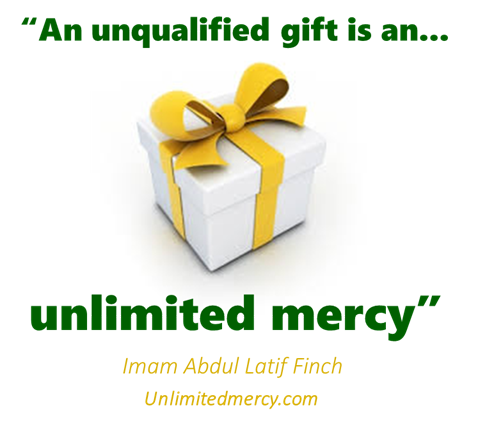
Something presented to another freely is a gift.

That which is presented absolutely freely is an unqualified gift.

An unqualified gift is an unlimited mercy.

The Creator, as indicated above, chose me to be born when He did as a mercy without limitation.

In this sense, birth is itself a proof for a Creator characterized with unlimited mercy.

Muhammad Abdul Latif Finch

Imam Muhammad Abdul Latif Finch’s website

Imam Muhammad Abdul Latif Finch’s Twitter page

Imam Muhammad Abdul Latif Finch’s LinkedIn page

Imam Muhammad Abdul Latif Finch’s Soundcloud page

Imam Muhammad Abdul Latif Finch’s Soundcloud page # 2

< Rest of Imam Abdul Latif Finch’s thoughts

< Imam Muhammad Abdul Latif Finch’s quotes

< Back to homepage

< About us

Tone Deaf – a thought from Imam Abdul Latif Finch

If one looks for pleasure or fulfillment outside of what God has permitted,

God permits them to be lost in the displeasure of distance from Him.

His allowance is not in reaction to the slave,

But rather, is an aspect of the laws of the universe.

Something laid down or fixed.

When someone goes against even the most minute fibers of the fabric of reality

They will find it an action spent in vain.

A waste.

The action is rejected like a bad note,

In a beautiful harmony,

Amongst limitless voices,

All resonating in one unified sound.

The heart of the offender,

In its cacophonic reverberation,

Is cast to the wayside,

No longer to be found.

Out of frequency and lost.

Muhammad Abdul Latif Finch

Imam Muhammad Abdul Latif Finch’s website

Imam Muhammad Abdul Latif Finch’s Twitter page

Imam Muhammad Abdul Latif Finch’s LinkedIn page

Imam Muhammad Abdul Latif Finch’s Soundcloud page

Imam Muhammad Abdul Latif Finch’s Soundcloud page # 2

< Rest of Imam Abdul Latif Finch’s thoughts

< Imam Muhammad Abdul Latif Finch’s quotes

< Back to homepage

< About us

Contentment – a quote by Imam Abdul Latif Finch

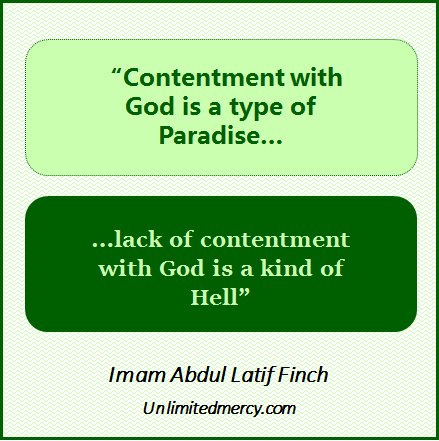
“Contentment with God is a type of Paradise. Lack of contentment with God is a kind of Hell.”

Imam Muhammad Abdul Latif Finch 2015

paradise and hell quote

Muhammad Abdul Latif converted to Islam at the age of 20 and has earned ijazas in Islamic Sciences including Quranic Sciences, Hadith, Maliki and Shafi’i Jurisprudence, Usul al-Fiqh, Seerah, Logic, and Arabic Grammar and Morphology under the tutelage of numerous scholars, including Shaykh Hamza Yusuf, Shaykh Salik bin Siddina, Imam Zaid Shakir, Shaykh Abdur Rahman Taahir, Qari Umar Bellahi, Shaykh Abdullah Ali, and Shaykh Yahya Rhodus.

Imam Muhammad Abdul Latif Finch co-founded the Lighthouse Mosque in Oakland, California where he served as the Imam till for 3 years until he resigned in 2012 to focus on his graduate studies. In addition, he was a teacher and a program developer for Deen Intensive Foundation, Seekers Guidance and has assisted Zaytuna College ‘s Summer Arabic Intensive program for three years in a row.

Imam Muhammad Abdul Latif Finch has recently attained a Master’s degree in Philosophy at the Dominican School of Philosophy and Theology, a member of the Graduate Theological Union in Berkeley.

Many thanks to Imam Muhammad Abdul Latif Finch for contributing to this blog.

Imam Muhammad Abdul Latif Finch’s website

Imam Muhammad Abdul Latif Finch’s Twitter page

Imam Muhammad Abdul Latif Finch’s LinkedIn page

Imam Muhammad Abdul Latif Finch’s Soundcloud page

Imam Muhammad Abdul Latif Finch’s Soundcloud page # 2

< Rest of Imam Muhammad Abdul Latif Finch’s quotes

< Imam Muhammad Abdul Latif Finch’s thoughts

< Back to homepage

< About us