UM Special: A Good Opinion of Allah

Good opinion of Allah 1

As salaam o alaikam wa rahmatullah wa barakatuh

We are pleased to have our first UM special on our site on having…

A Good Opinion of Allah

We will be posting ayahs from the Quran along with Hadiths and insights from Imam Muhammad Abdul Latif Finch on how we can all have a good opinion of Allah.

We at Unlimited Mercy pray that you benefit abundantly from these reminders and that they God willing bring you closer to Allah. Amin.

Unlimited Mercy Team

View posts on having A Good Opinion of Allah >>>

Becoming Children Again – a Thought by Imam Abdul Latif Finch

Abū Hurayra said, “I heard the Prophet (ﷺ) the truthful confirmed one, Abu’l-Qāsim, say, ‘Mercy is only removed from the one who is destined for wretchedness.” This wretchedness is evil for [1] in the tradition narrated by ‘Abdullah ibn Mas’ūd, may God be pleased with him, it states,

The evil one is he who is evil in the womb of his mother and the good one is he who takes a lesson from the (fate of) others. The narrator came to a person from amongst the Companions of Allah’s Messenger (ﷺ) who was called Hudhaifa b. Usaid Ghifari and said: How can a person be an evil one without (committing an evil) deed? Thereupon the person said to him: You are surprised at this, whereas I have heard Allah’s Messenger (ﷺ) as saying:

When forty-two nights pass after the semen gets into the womb, Allah sends the angel and gives him shape. Then he creates his sense of hearing, sense of sight, his skin, his flesh, his bones, and then says: My Lord, would he be male or female? And your Lord decides as He desires and the angel then puts down that also and then says: My Lord, what about his age? And your Lord decides as He likes it and the angel puts it down. Then he says: My Lord, what about his livelihood? And then the Lord decides as He likes and the angel writes it down, and then the angel gets out with his scroll of destiny in his hand and nothing is added to it and nothing is subtracted from it. [2]

The opposite of wretchedness or evil, is happiness or goodness. Whoever God has known in His pre-eternal knowledge to be wretched is in truth wretched, even if they appear to be happy, blessed and good. In truth, the truly wretched one is that person who enters into the Fire, a status that will not be known until the next life. As such, we don’t know our actual status with God until then. This is a sobering reality.

However, there are indications about our status in the next life to be found this world. This tradition, it appears, is one of the instructions from the Prophet ﷺ that gives us insight into the reality of our hearts and position with God. In principal, one cannot give another that which they don’t have themselves. So, if a person does not have goodness, mercy, and the like in their own hearts, they are not able to show toward other people. Thus his words, ﷺ , indicate that if we are not goodly to people it is because we can’t give them something that we ourselves do not have, i.e., mercy. In other words, the reason why we are not pleasant to them is because we don’t have that capacity in us ourselves and those who do not have this capacity are not fit for Paradise. In fact, they are suited for the Fire, the abode of wrath for those who hearts are devoid of mercy.

The tradition also indicates that the heart’s basis is in mercy, as he said, (ﷺ),‘Mercy is only removed from the one who is destined for wretchedness.’ This is to say that we are merciful by nature. Children, and overwhelmingly so, and the younger they are, tend to prove this statement to be true, as they are quite merciful and mercified from birth. In fact, when we encounter children that are not merciful we recognize that there is something amiss in their lives. May Allāh restore our child-like natures. Āmīn!

Imam Muhammad Abdul Latif Finch

October 2015


[1] Al-Bukhārī, Kitāb Adab al-Mufrad

[2] Ṣaḥīḥ Muslim

Imam Muhammad Abdul Latif Finch’s website

Imam Muhammad Abdul Latif Finch’s Twitter page

Imam Muhammad Abdul Latif Finch’s Facebook page

Imam Muhammad Abdul Latif Finch’s LinkedIn page

Imam Muhammad Abdul Latif Finch’s Soundcloud page

Imam Muhammad Abdul Latif Finch’s Soundcloud page # 2

< Rest of Imam Abdul Latif Finch’s thoughts

Receiving Allah’s Mercy – a quote by Imam Abdul Latif Finch

An extract from Imam Abdul Latif Finch’s thought ‘When you love something, you love its very self’

Mercy Thought quote 1b - Imam Abdul Latif Finch

Muhammad Abdul Latif converted to Islam at the age of 20 and has earned ijazas in Islamic Sciences including Quranic Sciences, Hadith, Maliki and Shafi’i Jurisprudence, Usul al-Fiqh, Seerah, Logic, and Arabic Grammar and Morphology under the tutelage of numerous scholars, including Shaykh Hamza Yusuf, Shaykh Salik bin Siddina, Imam Zaid Shakir, Shaykh Abdur Rahman Taahir, Qari Umar Bellahi, Shaykh Abdullah Ali, and Shaykh Yahya Rhodus.

Imam Muhammad Abdul Latif Finch co-founded the Lighthouse Mosque in Oakland, California where he served as the Imam till for 3 years until he resigned in 2012 to focus on his graduate studies. In addition, he was a teacher and a program developer for Deen Intensive Foundation, Seekers Guidance and has assisted Zaytuna College ‘s Summer Arabic Intensive program for three years in a row.

Imam Muhammad Abdul Latif Finch has recently attained a Master’s degree in Philosophy at the Dominican School of Philosophy and Theology, a member of the Graduate Theological Union in Berkeley.

Many thanks to Imam Muhammad Abdul Latif Finch for contributing to this blog.

Imam Muhammad Abdul Latif Finch’s website

Imam Muhammad Abdul Latif Finch’s Twitter page

Imam Muhammad Abdul Latif Finch’s LinkedIn page

Imam Muhammad Abdul Latif Finch’s Soundcloud page

Imam Muhammad Abdul Latif Finch’s Soundcloud page # 2

< Rest of Imam Muhammad Abdul Latif Finch’s quotes

< Imam Muhammad Abdul Latif Finch’s thoughts

< Back to homepage

< About us

Allah’s Division of Mercy – a hadith from a thought by Imam Abdul Latif Finch

An extract from Imam Abdul Latif Finch’s thought ‘When you love something, you love its very self’

Mercy Thought quote 1a - Imam Abdul Latif Finch

Muhammad Abdul Latif converted to Islam at the age of 20 and has earned ijazas in Islamic Sciences including Quranic Sciences, Hadith, Maliki and Shafi’i Jurisprudence, Usul al-Fiqh, Seerah, Logic, and Arabic Grammar and Morphology under the tutelage of numerous scholars, including Shaykh Hamza Yusuf, Shaykh Salik bin Siddina, Imam Zaid Shakir, Shaykh Abdur Rahman Taahir, Qari Umar Bellahi, Shaykh Abdullah Ali, and Shaykh Yahya Rhodus.

Imam Muhammad Abdul Latif Finch co-founded the Lighthouse Mosque in Oakland, California where he served as the Imam till for 3 years until he resigned in 2012 to focus on his graduate studies. In addition, he was a teacher and a program developer for Deen Intensive Foundation, Seekers Guidance and has assisted Zaytuna College ‘s Summer Arabic Intensive program for three years in a row.

Imam Muhammad Abdul Latif Finch has recently attained a Master’s degree in Philosophy at the Dominican School of Philosophy and Theology, a member of the Graduate Theological Union in Berkeley.

Many thanks to Imam Muhammad Abdul Latif Finch for contributing to this blog.

Imam Muhammad Abdul Latif Finch’s website

Imam Muhammad Abdul Latif Finch’s Twitter page

Imam Muhammad Abdul Latif Finch’s LinkedIn page

Imam Muhammad Abdul Latif Finch’s Soundcloud page

Imam Muhammad Abdul Latif Finch’s Soundcloud page # 2

< Rest of Imam Muhammad Abdul Latif Finch’s quotes

< Imam Muhammad Abdul Latif Finch’s thoughts

< Back to homepage

< About us

Representing Allah – a quote by Imam Abdul Latif Finch

An extract from Imam Abdul Latif Finch’s thought ‘He is wherever you are’ 

Imam Abdul Latif Finch thought quote 2

Muhammad Abdul Latif converted to Islam at the age of 20 and has earned ijazas in Islamic Sciences including Quranic Sciences, Hadith, Maliki and Shafi’i Jurisprudence, Usul al-Fiqh, Seerah, Logic, and Arabic Grammar and Morphology under the tutelage of numerous scholars, including Shaykh Hamza Yusuf, Shaykh Salik bin Siddina, Imam Zaid Shakir, Shaykh Abdur Rahman Taahir, Qari Umar Bellahi, Shaykh Abdullah Ali, and Shaykh Yahya Rhodus.

Imam Muhammad Abdul Latif Finch co-founded the Lighthouse Mosque in Oakland, California where he served as the Imam till for 3 years until he resigned in 2012 to focus on his graduate studies. In addition, he was a teacher and a program developer for Deen Intensive Foundation, Seekers Guidance and has assisted Zaytuna College ‘s Summer Arabic Intensive program for three years in a row.

Imam Muhammad Abdul Latif Finch has recently attained a Master’s degree in Philosophy at the Dominican School of Philosophy and Theology, a member of the Graduate Theological Union in Berkeley.

Many thanks to Imam Muhammad Abdul Latif Finch for contributing to this blog.

Imam Muhammad Abdul Latif Finch’s website

Imam Muhammad Abdul Latif Finch’s Twitter page

Imam Muhammad Abdul Latif Finch’s LinkedIn page

Imam Muhammad Abdul Latif Finch’s Soundcloud page

Imam Muhammad Abdul Latif Finch’s Soundcloud page # 2

< Rest of Imam Muhammad Abdul Latif Finch’s quotes

< Imam Muhammad Abdul Latif Finch’s thoughts

< Back to homepage

< About us

When You Love Something You Love Its Very Self – a thought by Imam Abdul Latif Finch

A Qurānic sign states, “Your Lord has inscribed Mercy on Himself.” (6:54) The ayah indicates, rather clearly it seems, that God has a Self. This Self has Mercy written all over it, to speak in the common vernacular. In other words, God’s Self and His Mercy are synonymous. We will attempt to show here that God’s ultimate mercy is with his very Self and those who reach that self-hood of Allāh are those who enjoy the fullness of His Mercy.

God’s Mercy is with His Very Self

God’s relationship with creation and our relationships with each other are based in Mercy. The tradition states, “Allah has divided mercy into 100 parts, and He retained with Him 99 parts, and sent down to earth 1 part. Through this one part creatures deal with one another with compassion, so much so that an animal lifts its hoof over its young lest it should hurt it.” (Al-Bukhārī) Naturally not every relationship is overflowing with obvious mercy, thus we know that there is some level of apportionment to each situation that we encounter. This division of mercy is accounted for in this tradition as 99 percent is with Him while the remaining 1% is amongst us. No doubt, this 1% is then further divided until it appears that some situations received no portion of mercy at all! Nonetheless, for our purposes, it is significant to note that the remaining 99% are actually with God, Himself. They aren’t with His angels, nor in His paradise or any other creature. Rather, these portions are, and most intimately so, with the Self of God.

We are Encouraged to Arrive to the Self

Every destination assumes at least four components: the travel, the path, the traveller and the destination. If one of these factors is missing there can be no endpoint to speak of. Without a terminus, travel has no purpose at all and to be devoid of purpose is to be meaningless. Surely revelation and meaninglessness are mutually exclusive concepts. In the Book God states, “And Allah warns you of Himself, and to Allah is the destination.” (3:28) Thus, the Self is of grave import for He is the Objective. As every target has the four constituents mentioned above, let it be understood that the travel is called worship, the path is known as Islām, the traveller is the worshipper, and the destination is God, Himself. This quranic sign also warns us about our destination. One must be careful regarding any warning by asking for guidance in dealing with whatever they have been warned about. As the path to the Self is termed Islām and Islām is the Straight Path, asking for guidance on the Straight Path daily, as per our recitation of al-Fātiḥa, is our encouragement to reach our Objective. The goal is God’s Self and thus we are encouraged to arrive to the Self.

Those Who Reach the Self are the Most-Mercified

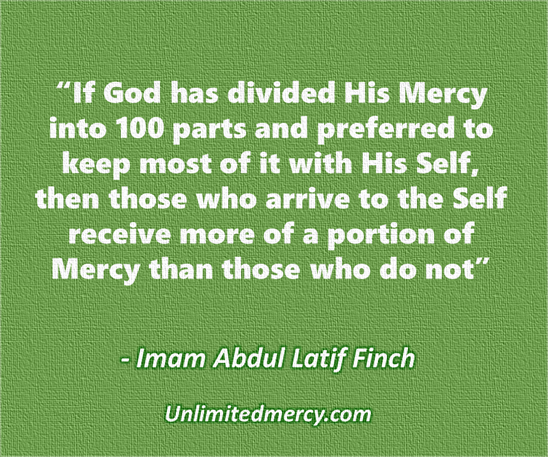
If 99% of something is greater than 1% of it, then it follows that whoever has that larger percentage has more of it. If God has divided His Mercy into 100 parts and preferred to keep most of it with His Self, then those who arrive to the Self receive more of a portion of Mercy than those who do not. Those who are fortunate to receive more of the Mercy are, in this sense, more mercified than others. Thus, those who reach the Self are the Most-Mercified.

Warning is Itself a Mercy

We have stated that God’s apportioned Mercy is predominately with His very Self. We also demonstrated that these helpings are, and most personally so, with the Self of God. Thereafter we have shown that our goal is God’s Self and that like all goals we are called to arrive to the Self. As shown, those who arrive to the Self are the Most-Mercified. Those who do not arrive are in a sense devoid of Mercy. Those devoid of Mercy face some kind of non-mercy. Whoever lacks some of the mercy of His Lord has not been fully guided. Whoever has not been fully guided has some level of misguidance. The Book states, “And who despairs of the mercy of his Lord, but such as go astray?” (15:56).

It may be said, then, that to whatever degree we suffer from misguidance, i.e., non-mercy, is the degree to which we are astray. As most of us have not reached this Self-ness described here, we remain asking God for guidance daily, “Guide us on the Straight Path.” The recitation of al-Fatiha is a divine mandate. Thus asking for guidance is a command from God. The quranic sign states, “And Allah warns you of Himself, and Allah is Kind to [His] servants.” (3:30) In other words God has warned us of His Self, via revelation. We are therefore instructed to reach Him and to thereby avoid the consequences of not doing so, i.e., not enjoying full Mercy. To be warned of consequences is to be enabled to evade them. One evades harm through guidance. We do not ask but that God has already granted us our request. Thus to request for guidance daily is a kindness to those who ask for it, i.e., the servants. In this sense, warning itself is a mercy.

As His Self and His Mercy are in fact synonymous, God’s Self is the epitome of Mercy. Those who reach that self-hood of Allāh are those who enjoy the fullness of Mercy while those who do not ask for it daily. This appears to be the essence of guidance. Whoever despairs of the mercy of His Lord, which lies ultimately at His very Self-hood, it appears, has not been fully guided. Whoever has not been fully guided has some level of misguidance. To whatever degree we suffer from misguidance is the degree to which we are astray. As most of us have not reached this Self-ness, and are therefore in need, thus we remain asking God for guidance everyday, “Guide us on the Straight Path.” Those who have attained to it know that this is a permanent condition for Mercy will always belong to the Self. Thus their request is for the Self, constantly. May Allāh give us Allāh, Himself.

Imam Muhammad Abdul Latif Finch

Aug 2015

Imam Muhammad Abdul Latif Finch’s website

Imam Muhammad Abdul Latif Finch’s Twitter page

Imam Muhammad Abdul Latif Finch’s Facebook page

Imam Muhammad Abdul Latif Finch’s LinkedIn page

Imam Muhammad Abdul Latif Finch’s Soundcloud page

Imam Muhammad Abdul Latif Finch’s Soundcloud page # 2

< Rest of Imam Abdul Latif Finch’s thoughts
Thikr (Rememberance) – a thought by Imam Abdul Latif Finch

zikr

Many of us find it terribly hard to enjoy thikr.

Remembrance is a good thing, we know it, but we don’t actually enjoy it.

We do other things for pleasure, frankly.

What we need to understand is that thikr is God’s pleasure.

When we please God our souls are pleased.

When our souls are pleased we are content.

When we are content we always remember why.

When we remember why we are thankful.

This causes us to say, “al hamdu lillah” from our soul to its Creator…pleased and pleasing, inshallah.

Imam Muhammad Abdul Latif Finch

July 2015

Imam Muhammad Abdul Latif Finch’s website

Imam Muhammad Abdul Latif Finch’s Twitter page

Imam Muhammad Abdul Latif Finch’s Facebook page

Imam Muhammad Abdul Latif Finch’s LinkedIn page

Imam Muhammad Abdul Latif Finch’s Soundcloud page

Imam Muhammad Abdul Latif Finch’s Soundcloud page # 2

< Rest of Imam Abdul Latif Finch’s thoughts

Trouble free-ness – a thought from Imam Abdul Latif Finch

paradise

It seems like every person wants their life to be trouble-free.

There is nothing in this world that is free from trouble.

So, where do we get this notion of trouble-free-ness from?

Since all of us regardless of our backgrounds and times long for this kind of life, without having ever experienced it here.

This collective condition indicates that all of us without exception, know of it but from some other time and place; one we’ve all experienced and remember.

This life that we recall that is free from problems and consequently attempt to re-create here was in paradise.

Imam Muhammad Abdul Latif Finch

July 2015

Imam Muhammad Abdul Latif Finch’s website

Imam Muhammad Abdul Latif Finch’s Twitter page

Imam Muhammad Abdul Latif Finch’s Facebook page

Imam Muhammad Abdul Latif Finch’s LinkedIn page

Imam Muhammad Abdul Latif Finch’s Soundcloud page

Imam Muhammad Abdul Latif Finch’s Soundcloud page # 2

< Rest of Imam Abdul Latif Finch’s thoughts
Ultimate End | from ‘Soft Hearts’ – a recording by Imam Abdul Latif Finch

Below is a quote from Imam Abdul Latif Finch’s short talk on ‘SOFT HEARTS’

Click HERE to listen to the Soft Hearts recording

soft heart 2

Muhammad Abdul Latif Finch converted to Islam at the age of 20 and has earned ijazas in Islamic Sciences including Quranic Sciences, Hadith, Maliki and Shafi’i Jurisprudence, Usul al-Fiqh, Seerah, Logic, and Arabic Grammar and Morphology under the tutelage of numerous scholars, including Shaykh Hamza Yusuf, Shaykh Salik bin Siddina, Imam Zaid Shakir, Shaykh Abdur Rahman Taahir, Qari Umar Bellahi, Shaykh Abdullah Ali, and Shaykh Yahya Rhodus.

Imam Muhammad Abdul Latif Finch co-founded the Lighthouse Mosque in Oakland, California where he served as the Imam till for 3 years until he resigned in 2012 to focus on his graduate studies. In addition, he was a teacher and a program developer for Deen Intensive Foundation, Seekers Guidance and has assisted Zaytuna College ‘s Summer Arabic Intensive program for three years in a row.

Imam Muhammad Abdul Latif Finch has recently attained a Master’s degree in Philosophy from the Dominican School of Philosophy and Theology, a member of the Graduate Theological Union in Berkeley.

Many thanks to Imam Muhammad Abdul Latif Finch for contributing to this blog.

< Imam Muhammad Abdul Latif Finch’s recordings

< Imam Muhammad Abdul Latif Finch’s lectures

< Imam Muhammad Abdul Latif Finch’s quotes

< Imam Muhammad Abdul Latif Finch’s thoughts

< Imam Muhammad Abdul Latif Finch’s articles

< Back to homepage

Soft Hearts – a recording my Imam Abdul Latif Finch

Below is a quote from Imam Abdul Latif Finch’s short talk on ‘SOFT HEARTS’

Click HERE to listen to the Soft Hearts recording

hard heart

Muhammad Abdul Latif Finch converted to Islam at the age of 20 and has earned ijazas in Islamic Sciences including Quranic Sciences, Hadith, Maliki and Shafi’i Jurisprudence, Usul al-Fiqh, Seerah, Logic, and Arabic Grammar and Morphology under the tutelage of numerous scholars, including Shaykh Hamza Yusuf, Shaykh Salik bin Siddina, Imam Zaid Shakir, Shaykh Abdur Rahman Taahir, Qari Umar Bellahi, Shaykh Abdullah Ali, and Shaykh Yahya Rhodus.

Imam Muhammad Abdul Latif Finch co-founded the Lighthouse Mosque in Oakland, California where he served as the Imam till for 3 years until he resigned in 2012 to focus on his graduate studies. In addition, he was a teacher and a program developer for Deen Intensive Foundation, Seekers Guidance and has assisted Zaytuna College ‘s Summer Arabic Intensive program for three years in a row.

Imam Muhammad Abdul Latif Finch has recently attained a Master’s degree in Philosophy from the Dominican School of Philosophy and Theology, a member of the Graduate Theological Union in Berkeley.

Many thanks to Imam Muhammad Abdul Latif Finch for contributing to this blog.

< Imam Muhammad Abdul Latif Finch’s recordings

< Imam Muhammad Abdul Latif Finch’s lectures

< Imam Muhammad Abdul Latif Finch’s quotes

< Imam Muhammad Abdul Latif Finch’s thoughts

< Imam Muhammad Abdul Latif Finch’s articles

< Back to homepage